
Moore County Court Docket Searches
Want a free Moore County court docket search online? Start at the North Carolina eCourts Portal. SMART SEARCH is its public tool. It pulls Moore County records along with the rest of the state. You can query by party name, case number, citation number, business name, or a mix of advanced criteria. The portal is view-only. File & Serve, a separate service, exists for authenticated electronic filing. Nobody needs a filing account just to read a public Register of Actions.
Begin with the exact spelling from a court paper, or with the case number. If a statewide name search returns too much, apply the Moore County location filter. Click the underlined case number and work through the Case Summary in date order. Results can still come back thin. Several things can hide part of the docket. A misspelled name, restricted material, or a document not yet uploaded will do it. So will an older file still sitting with the clerk.
- Open SMART SEARCH and enter a party name, citation number, or case number.
- Use the Moore County location filter when similar statewide results appear.
- Open the underlined case number to reach the Register of Actions.
- Check Case Events, Dispositions, and Hearings, then use Search Hearings for the current setting.
- Use the Clerk of Superior Court or the courthouse terminal for a paper file, unavailable public item, or certified copy.
Note: Portal does not let the public search by charge. Party-name or case-number searches are the practical way into a Moore County criminal docket.
Moore County Court Docket Portal
SMART SEARCH begins with a single basic criterion. The default is a case number or a party name. Official Portal materials list more options: citation number, attorney name or bar number, business name, cross-reference number, and even nickname. Advanced filters can tighten a broad result. They cannot carry a search alone. When the exact name is uncertain, a valid wildcard works, as long as your entry satisfies the Portal's minimum character rules.
| Portal field | Use in a Moore County search | Helpful limit |
|---|---|---|
| Basic Search Criteria | Enter a case number or party name. | One basic criterion is required. |
| Location | Choose Moore County to narrow statewide matches. | Use with a basic search. |
| Case Type and Status | Refine a public case category and status. | Values depend on case type. |
| Filing Date Range | Limit results by filing period. | Optional advanced filter. |
| Underlined Case Number | Open the Register of Actions / Case Summary. | Public records remain subject to restrictions. |
When the portal can't answer a local question, the official Moore County court landing page supplies contacts, forms, schedules, and payment details.
The North Carolina eCourts overview documents the statewide Enterprise Justice conversion that brought Moore County into one shared system. That statewide reach is exactly why a county filter matters after any name search.
The eCourts overview draws a clear line. One public search layer sits on top, while the county clerk keeps local custody of each file in Moore County.
Court Dockets: What They Show
A Moore County Case Summary is a chronological case index. It is not a copy of every document in the file. Public information varies with the case. It can cover case and assignment details, parties, events, hearings, dispositions, and financial information. Civil, family, probate, and mental-health entries may add Causes of Action. Documents themselves appear only when they are public, nonconfidential, nonsealed, and uploaded.
Read the event history in order. Just don't treat an old hearing event as a confirmed current appearance. The Hearings module can be missing when nothing displays. Portal's separate Search Hearings feature gives better current time and location. Even after a disposition or closed status, check later entries. Post-disposition activity can still show up in the docket.
| Case information | Case number, assignment, type, and status context. |
|---|---|
| Party information | Public party information associated with the case. |
| Case Events | The dated Register of Actions timeline. |
| Hearings | Hearing information when data exists; confirm current settings through Search Hearings. |
| Dispositions | Final or interim outcome labels and case status. |
| Documents | Public uploaded documents, available one at a time. |
Moore County Court Docket Numbers
Enterprise Justice case numbers stack up four parts: a two-digit year, case-type letters, a six-digit sequence number, and a three-digit county identifier. Moore County's identifier is 620. A format-only example looks like 26CR000001-620. The letters hint at the case category, nothing more; they never replace the court's actual case description or outcome.
- Register of Actions
- The Portal name for the chronological court docket.
- Case Summary
- An alternate Portal label for that record.
- CR
- A case number containing at least one criminal offense or misdemeanor.
- IF
- An infraction-only traffic case indicator.
- Disposed
- A status showing that the core case has reached an outcome, while later activity may still be listed.
The Judicial Branch county-code publication lists the statewide county identifiers used in this numbering system. A complete case number usually beats a broad name search for precision.
The code reference helps explain what the Moore County suffix means. Treat it as a format clue only, not a conclusion about the case itself.
Moore County Courts and Their Dockets
North Carolina runs one statewide court system. It is not a patchwork of city court-record offices. In Moore County, the Clerk of Superior Court holds the files and indexes for both Superior Court and District Court. Superior Court takes felony criminal cases plus civil actions generally above $25,000. District Court handles misdemeanors and infractions. It also takes family cases, juvenile matters, and civil actions at or below $25,000. Magistrates sit inside the District Court structure. They handle small claims, certain preliminary criminal matters, warrants, bail, and limited pleas.
| Trial level | Typical Moore County matters | Record route |
|---|---|---|
| Superior Court | Felonies and larger civil actions. | Portal and the Moore Clerk. |
| District Court | Misdemeanors, infractions, family matters, juvenile cases, and lower-value civil actions. | Portal and the Moore Clerk. |
| Magistrates | Small claims, summary ejectment, warrants, bail, and limited minor matters. | Unified clerk docket and Portal where public. |
| North Carolina Court of Appeals | Separate appellate records after a trial-level appeal. | Appellate court records, not the county Register alone. |
Note: A case tied to Pinehurst, Southern Pines, Aberdeen, Whispering Pines, or Carthage still runs through the same county courts. No separate municipal court docket exists for those towns.
Moore County Unified Court Docket Clerk
The single-clerk setup invites confusion. Different courtrooms, one clerk. A criminal infraction, small claim, estate, civil case, and felony each land in different courtrooms. Even so, Moore County does not split those files between a county clerk and a district clerk. The Moore County Clerk of Superior Court keeps the files and indexes for both trial divisions. Portal is only the public display layer, not a county-built database.
The official Moore County contact directory breaks out the clerk, Superior Court, District Court, Family Court, magistrates, and the district attorney. Calling the right channel helps with a specific question. Need public inspection, copies, or certification of any Moore County court docket? The clerk remains the office to ask.
That directory is the reminder: a calendar question and a case-file copy request can lead to two different local contacts in Moore County.
Court Dates and Settings in Moore County
A Moore County docket setting is a scheduled event. It is not a promise of trial that day. Treat it as a placeholder until the case moves. The Portal's Search Hearings tool shows the current hearing time and place. You can pull it up by case number, party name, business name, attorney, judicial officer, or courtroom. Once you find a case, compare that live result against the hearing history listed in the Case Summary, since past entries may show resets or continuances. The local administrative schedules page adds civil and criminal calendar links too.
Want a fuller walk-through of date searching? See the Moore County court schedule. The practical order is simple: Portal first, then Search Hearings, then the local calendar link. Does the online answer still look uncertain? Call the right court contact or visit the clerk's public terminal.
Moore County Court Docket Hearing Search
Search Hearings pairs with SMART SEARCH. Together they form the current-calendar side of a Moore County court docket lookup. It earns its keep when a Register entry shows an old setting, a reset, or a continuance. Then you need to know what stands now. The result gives the case number, courtroom, judicial officer, date range, and location. One caution. It will not tell a public user whether an appearance is virtual or in person. Any remote hearing link comes from the clerk. It sits outside Portal.
For the official calendar channel, the Moore County administrative schedules page publishes the local civil and criminal calendars. Civil Superior Court scheduling also runs through a local calendar-request process. That belongs to the parties and court administration, not to a general public search.
The official Moore County court landing page gathers the local judicial services that sit alongside any hearing search, from schedules to forms to payment options.
That local services listing places a Moore County hearing search beside the official schedules, forms, contact channels, and payment information a visitor may also need.
Docket Access Under North Carolina Law
Moore County gives the public two access paths. Portal carries public online information. The Clerk of Superior Court opens county files for public inspection during regular office hours. Neither path is total. An online result does not put every paper document on the web. State law permits redaction of confidential portions. Records protected by law or court order stay restricted.
Key Rules:
G.S. 7A-109 requires clerks to keep court records, files, dockets, and indexes and generally makes them open to inspection.
G.S. 132-6 addresses reasonable public inspection and copies on payment of lawful fees.
G.S. 7B-3000 protects juvenile records from ordinary public inspection except as the law or a court order permits.
Moore County Restricted Court Dockets
Portal hides sealed or confidential data, documents, and entire cases from an ordinary public user. Juvenile material, unreturned warrants, and certain protective-order information fall under access limits. The Portal materials describe those limits. Public results also mask the month and day of a recorded birth date. They do not validate Social Security numbers. Keep this in mind: a missing result never proves that no court event exists.
Why a case stays invisible online depends on the reason, so start with the basics. Check the spelling and the case-number format first. A record may be public but not readily displayed. A courthouse terminal or a paper-file inquiry at the clerk's office can help then. The clerk will explain the access route. No statute or order lets the clerk open a protected file, though. That line preserves public court access without mistaking a search screen for the complete file.
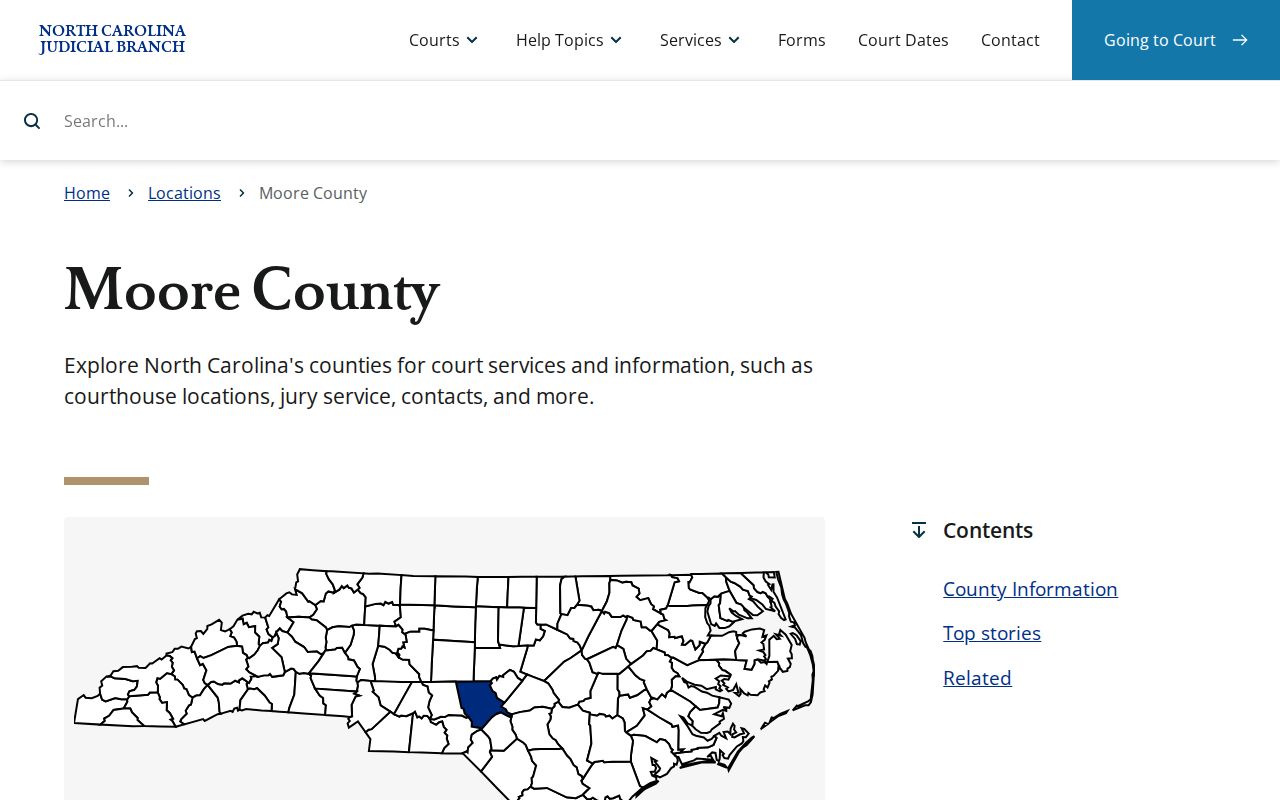
The official Moore County Courthouse page identifies the local court facility and its access information.
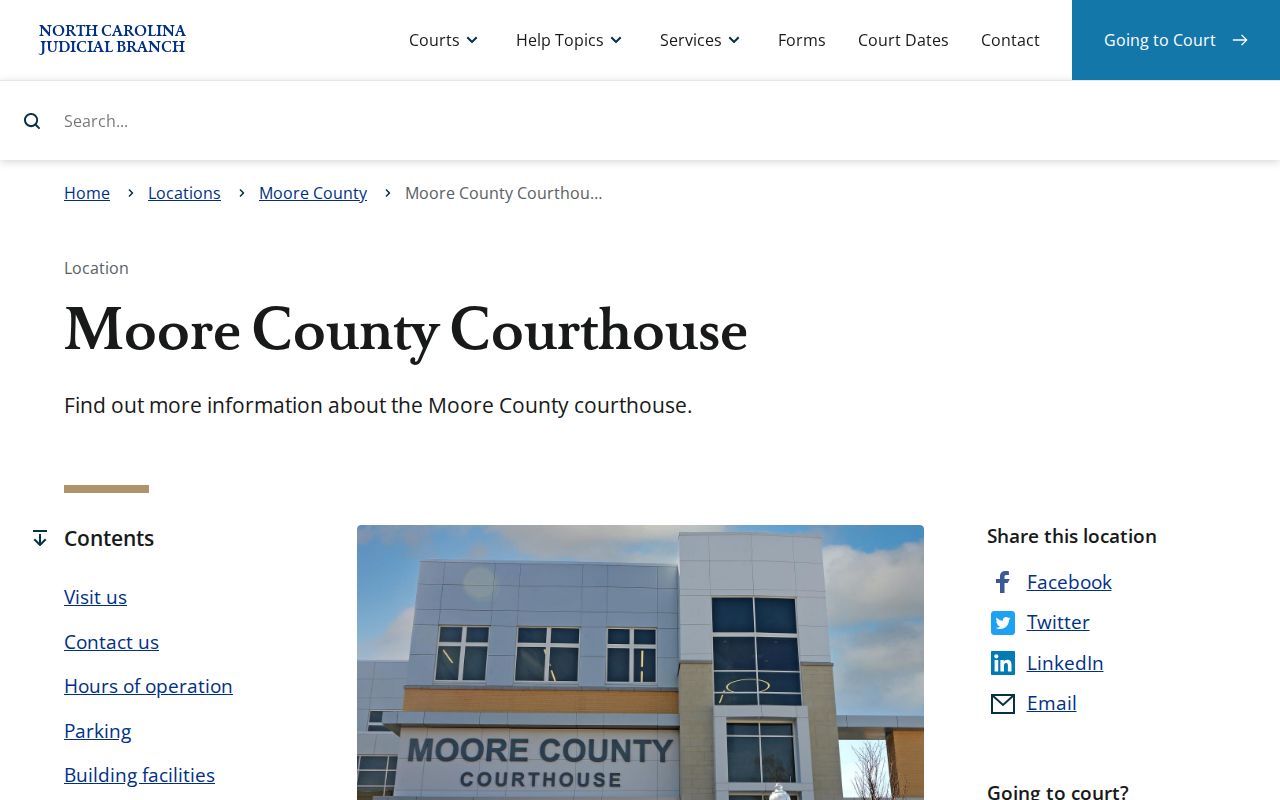
The courthouse listing is a useful reminder: when a Moore County web search comes up short, clerk-held access at the local courthouse still matters.
How the Clerk Keeps Docket Records
For court-file copies, certified copies, historical-file questions, and public self-service terminals, the Moore County Clerk of Superior Court is the local source. Courthouse guidance places the clerk and the trial courts at the Moore County Courthouse/Courts Facility Building. Statewide records guidance adds that a clerk-office terminal can reach criminal, civil, special proceeding, and estate information, while paper files may remain in the county where the case is located.
Moore County Clerk of Superior Court
Moore County Courthouse/Courts Facility Building
102 Monroe Street, Carthage, NC 28327
(910) 722-5000
Public hours run 8 a.m. to 5 p.m. on weekdays, and the courthouse warns that parking is very limited. Call the court about current closures before you drive over.
The county history listing ties the physical courthouse record trail to Moore County's older research needs, where the answers may still live on paper.
Moore County Court Record Copies
Three kinds of records get confused here, so sort them out. A Register of Actions is the case index and timeline. A filed pleading, order, judgment, or notice is a document. It sits behind one of those entries. A certified copy is a clerk-authenticated official copy of that document. Portal may display a public document, but it cannot certify anything. For a certified record, give the clerk the case number and a document description. Ask for a cost estimate, and state whether you need certification or exemplification.
| Clerk service | Statutory amount |
|---|---|
| First page of each copied document | $2.00 |
| Each additional page or fraction | $0.25 |
| Certificate under seal | $3.00 |
| Exemplification | $10.00 |
| Single-county certified criminal record search | $25.00 |
G.S. 7A-308 controls what the clerk may charge. The NCAOC public-records form covers records that state agency itself holds; it does not make NCAOC retrieve or certify a Moore County case file.
City-by-City Court Dockets in Moore County
Moore County's five largest incorporated municipalities, per the county's 2020 Census table, all feed state-court matters into the same county and state system. None runs its own municipal court docket. A town officer's state Uniform Citation lands in Moore County District Court. It is searchable through Portal or the clerk. A town parking penalty or police record may follow a separate local administrative route instead.
Pinehurst Court Records
17,581 residents in the 2020 Census. Police citation search and Village payment channels do not replace the state court record.
Southern Pines Court Records
15,545 residents. A town parking review is distinct from a Uniform Citation in District Court.
Aberdeen Court Records
8,516 residents. Police and crash records are separate from the court case record.
Whispering Pines Court Records
4,987 residents. Village record requests do not replace a clerk-held court-file request.
Carthage Court Records
2,775 residents. Town Hall and the state courthouse serve different record functions.
The county's incorporated-place data supplies the 2020 population context for these links.
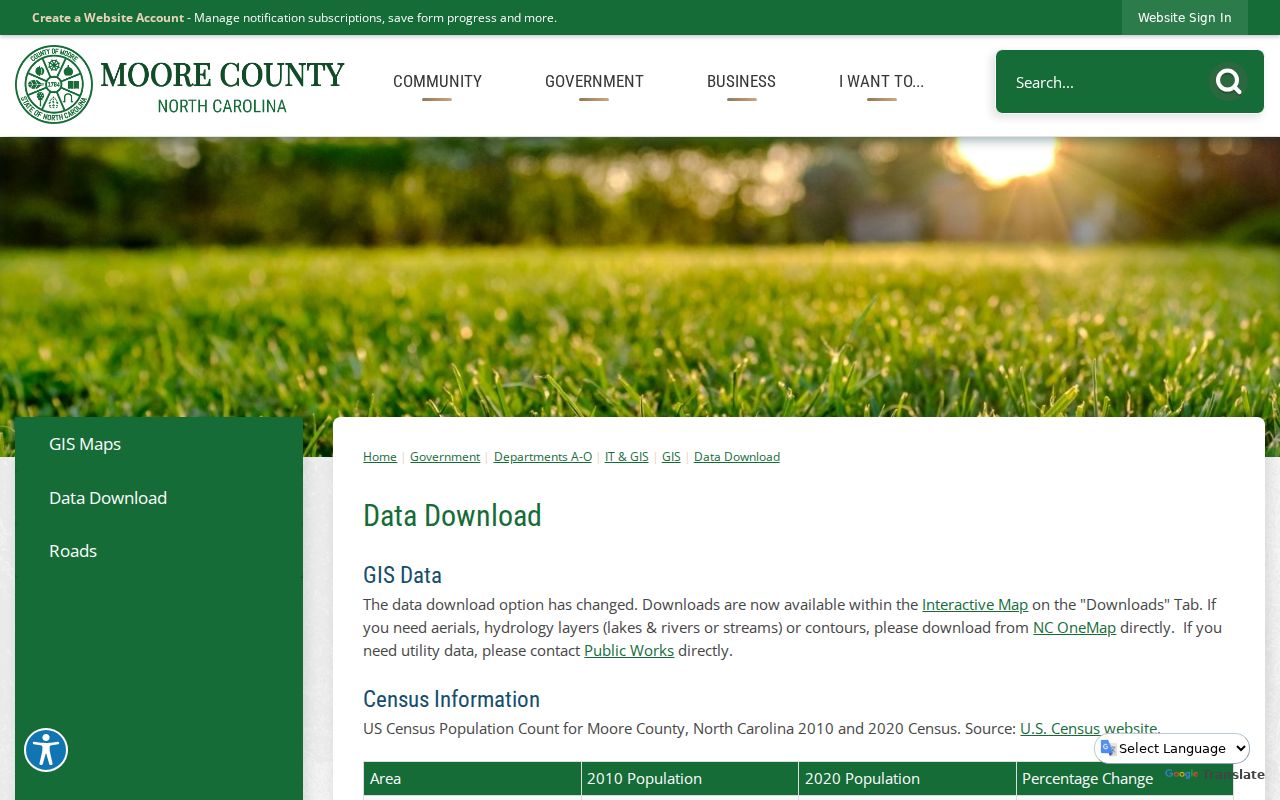
The county data behind the city list still points one way: court custody in Moore County is countywide, whatever the town on the ticket.
Moore County Court Docket Migration
Moore County moved onto Enterprise Justice, Portal, and File & Serve on October 14, 2024. North Carolina finished the statewide conversion a year later, on October 13, 2025. Portal carries over records from older systems. Historic paper files may still sit with the clerk, though. Expect a quirk, too. Some legacy entries show a 12:00 a.m. timestamp. That is simply how converted data was tagged, so treat it as a convention rather than the real hour of the event.
Older Moore County court records carry a second caution. An 1889 courthouse fire destroyed some county records. That does not mean every court file burned. Before assuming a historic case is gone, describe the matter and its year to the clerk. A modern docket search that turns up nothing is not proof the file never existed. The official Moore eCourts announcement lays out the county's transition in detail.
The Moore eCourts transition image supplies local context for how the Register of Actions handles portal and migration entries in a Moore County court docket.
For wider background on the county served by this unified access system, Census QuickFacts for Moore County covers the population and demographics.
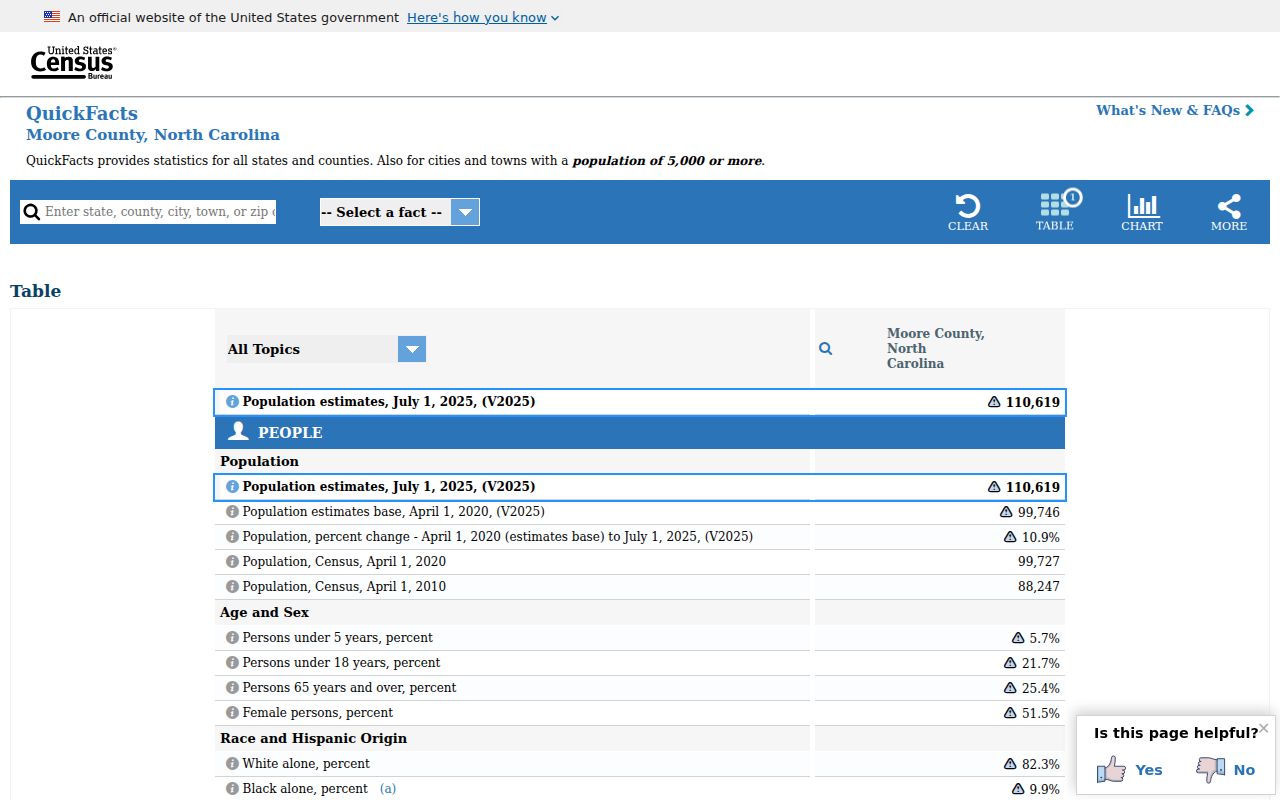
The Census image gives current county context without changing the unified court record route.
Map and Directions to the Moore County Courthouse
Superior Court, District Court, magistrate, and Clerk of Superior Court records are all kept at the Moore County Courthouse/Courts Facility Building, 102 Monroe Street, in downtown Carthage. The current historic courthouse dates to 1922–1923 and was renovated for ADA access beginning in 1999, with an elevator completed in 2000. A basement-level door serves as the wheelchair entrance, and the building also has vending machines.
Moore County Courthouse/Courts Facility Building
102 Monroe Street
Carthage, NC 28327
(910) 722-5000
Weekdays, 8:00 a.m. to 5:00 p.m.
The courthouse's own notice warns that parking is very limited, with the closest area behind the Register of Deeds Office on Dowd Road; visitors called for jury service instead get free parking on Ray Street, across from the U.S. Post Office beside Carthage Presbyterian Church. No security-screening or prohibited-items list is published, so a call ahead is the safer plan.