
Moore County Civil Docket Searches
Most Moore County civil case information starts at the North Carolina eCourts Portal. It is the statewide public entry point. SMART SEARCH takes an Enterprise Justice record number or a party name. A common name will pull results from many counties. Add the Moore County location filter to narrow them down. Record numbers run year, case-type letters, a six-digit sequence, and a county identifier. So 26CV000001-620 shows the shape of a Moore number without pointing to a real file.
Before opening any result, read its type and assignment information. One person can sit in a civil action, a family matter, an estate, or a special proceeding. Each category changes what the Case Summary displays. Portal is view-only for public case information and documents. Anything filed goes through separate authenticated File & Serve, never through the public docket.
- Start SMART SEARCH with a party name or known case number.
- Use the Moore County location filter and current case-type filter when helpful.
- Open the underlined result and identify the division, case type, and parties.
- Read Case Events in order, then check Hearings, Dispositions, and Financial Information when shown.
- Contact the Clerk of Superior Court for a paper file, a public terminal, or certified copy instructions.
Moore County Civil Docket Divide
Trial division matters in a Moore County civil docket. G.S. 7A-243 draws the general line. District Court usually handles civil actions at $25,000 or less. Superior Court usually handles claims above that amount, subject to statutory exceptions. Family matters stay in District Court. The same Clerk of Superior Court custody and the same Portal search route cover both divisions.
The statute sets the threshold courts use to sort civil cases between the two trial divisions.
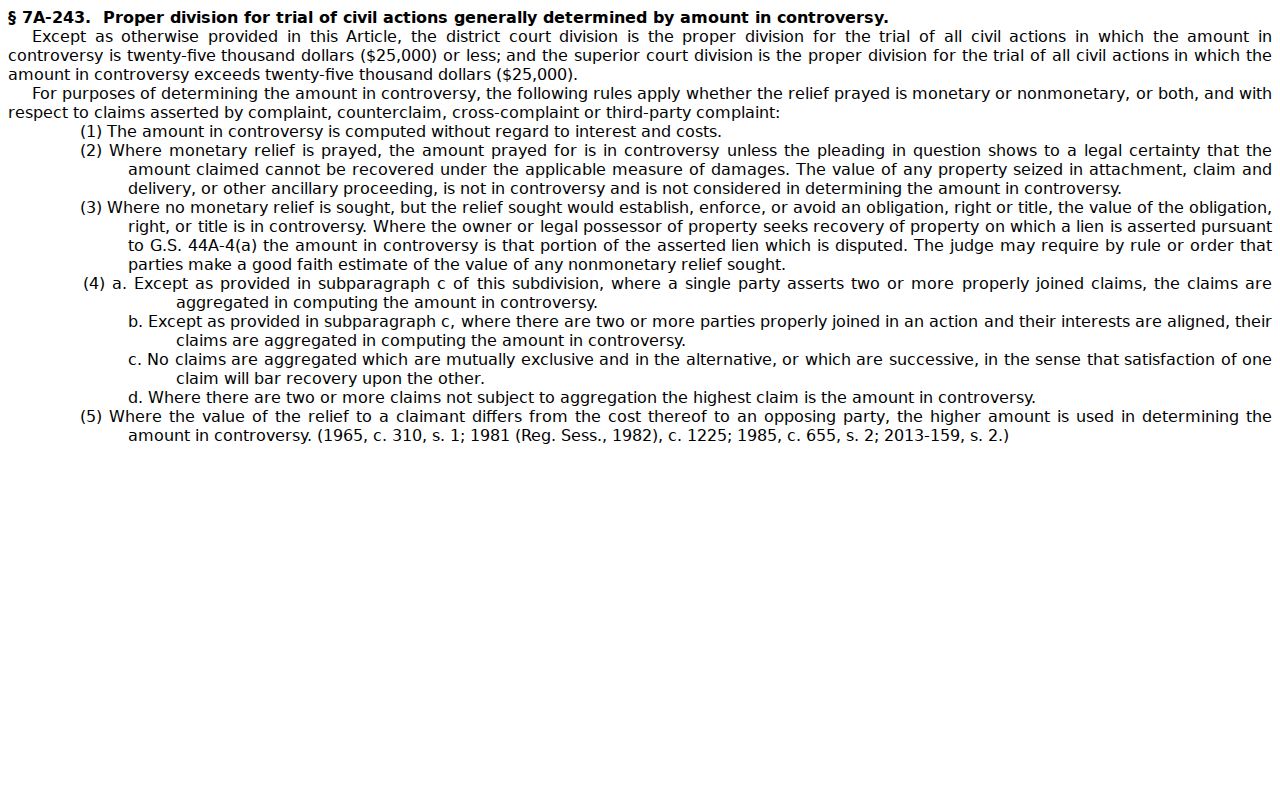
Treat that threshold as a sorting aid. It never replaces the assignment information printed in a Moore County civil docket.
Civil Dockets: What They Show
A Moore County civil Case Summary on Portal can display Case Information, Assignment Information, Party Information, Causes of Action, Case Events, Dispositions, Hearings, and Financial Information where they apply. Causes of Action cover Civil, Family, Probate, and Mental Health categories. Think of the Register of Actions as the dated index and timeline. The orders, pleadings, notices, and judgments sit behind it as documents.
| Case number | The Enterprise Justice identifier connects the case to the year, type, sequence, and Moore County code. |
|---|---|
| Parties | Lists the people or entities and their roles, such as plaintiff, defendant, petitioner, or respondent. |
| Causes of Action | States the displayed basis of a civil, family, probate, or mental-health claim; it is not the outcome. |
| Case Events | Provides the chronological procedural record, including filings, motions, orders, or setting-related events. |
| Disposition | Shows a Portal status such as Closed, Appealed, Stayed, a judgment form, or a dismissal form. |
Downloads happen one document at a time. A file must be public, nonconfidential, nonsealed, and uploaded to appear. An online image is never a clerk-certified copy.
Moore County Civil Docket Case Types
No separate local database exists for Moore County civil docket searches. The unified search can surface civil actions, family matters, probate or estate cases, and special proceedings held by the clerk. Reading the case type first keeps a larger civil action from getting confused with a small claim or a clerk-centered estate matter.
- Civil actions generally assigned to District Court or Superior Court according to jurisdiction.
- Family matters in District Court.
- Small claims and related magistrate matters within the District Court structure.
- Estates and special proceedings in the unified Clerk of Superior Court docket.
- Public probate and mental-health categories that can show Causes of Action when Portal provides them.
Note: A civil case label names the court category. The Register of Actions supplies the real case events and present status.
What Cases Fill the Civil Docket
Moore County small claims show the unified system at work locally. Magistrates generally hear those cases. The statewide court description allows a limit as high as $10,000. A party unhappy with a small-claims judgment can appeal. The appeal brings a new District Court trial. That appeal path stays a court record with the Moore Clerk. It is not a separate town or county-civil docket.
The North Carolina Small Claims Court page explains the magistrate role. It also covers the statewide small-claims limit.
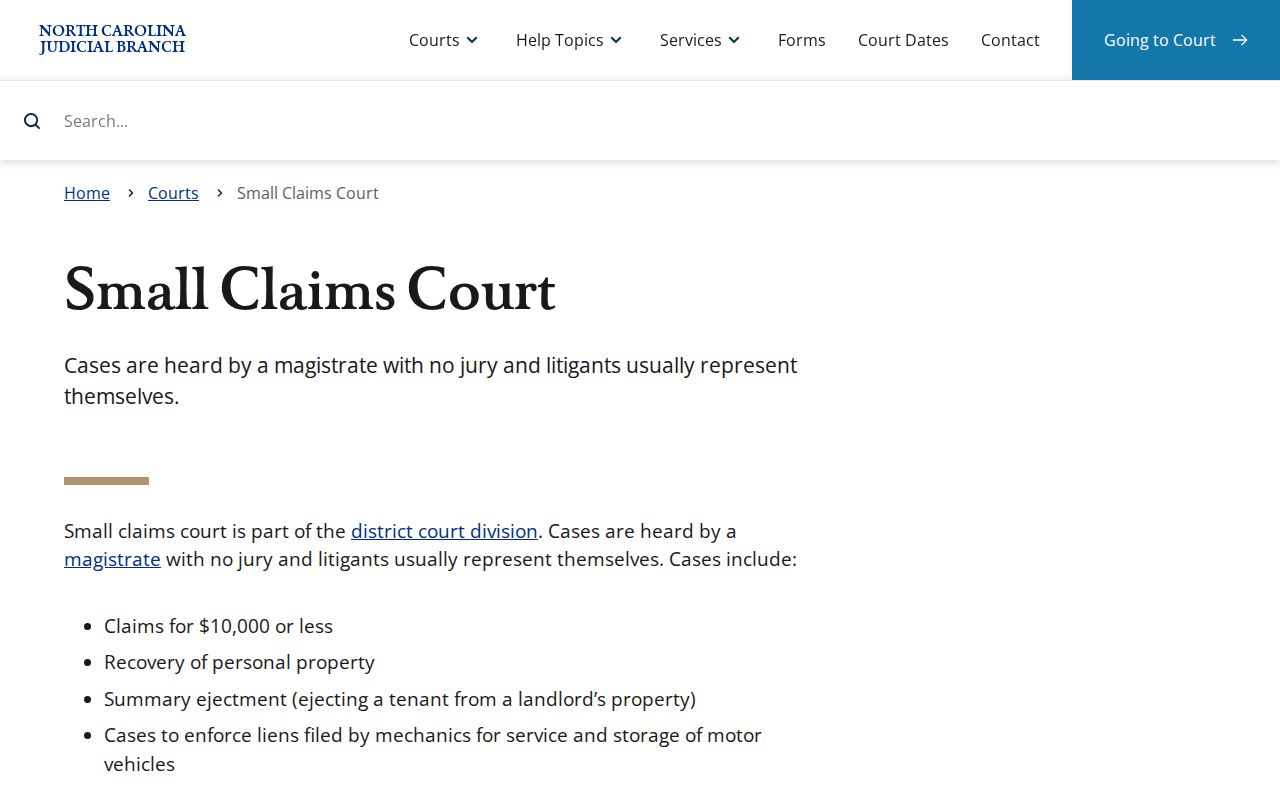
For any Moore small-claims result, the case number, assignment, and later Register entries give the case-specific answer.
Moore County Civil Docket Calendar Requests
Moore's Civil Superior Court Calendar Request form shows how a party asks for a civil motion or trial setting. It collects the caption, file number, requested session, motion type, jury or non-jury selection, filing date, estimated time, conference and agreement answers, and certification. The original goes to the Moore Clerk. The request goes to the Judicial Assistant, and copies get served as the form directs.
A calendar request is not a confirmed hearing. The form itself says a motion will not be placed on the calendar until it is filed. Members of the public should not use it to set another person's case. For a live date, try Portal Search Hearings. The county's posted civil calendars also work, as does the local court contact channel.
The Moore County payment information page covers a separate local service. Payment instructions do not establish a civil hearing date.
Calendars and payment channels serve different purposes. The case's current hearing record stays the right source for a setting.
Hearings on the Civil Docket
A civil setting in Moore County is a real court date. It is not just a Superior Court term printed on a yearly session plan. To pin down the place and time, run a Portal Search Hearings lookup. Search by case number, party or business name, attorney or bar number, judicial officer, or courtroom. Then check the Case Summary Hearings module too. The newest event history helps as well. Moore's local administrative schedules add another official channel. They post civil and criminal calendar links for the county.
A continuance means the matter was postponed. Read it from the most recent hearing or event entry, not from an older date. If the online information leaves a setting unclear, call. Superior Court coordination answers at (910) 722-5016. The Clerk of Superior Court can be reached at (910) 722-5000.
Moore County Civil Docket Statuses
Portal status labels on a Moore County civil case include Pending, Active, Filed, Closed, Reopened, Appealed, Stayed, Disposed–Final Judgment No Trial, Disposed–Trial by Judge, Disposed–Trial by Jury, Disposed–Trial by Magistrate, and the dismissal forms. One label trips readers up. "Disposed–Post Disposition Activity" signals work that continued after the central disposition. So later Register entries still matter.
An appeal out of District or Superior Court usually goes next to the North Carolina Court of Appeals. That appellate docket is separate from the trial-level case summary. Treat the two as different records. The Court of Appeals page explains the separate role of the appellate court. Check both dockets during a docket search.
A closed label is not the whole history. Reading the status alongside the last few Moore County civil docket events keeps the fuller picture in view.
Access Rules for Civil Dockets
Public civil case information shows up in Portal when the case is public. The item must be public too. Not everything public is online, though. The courthouse public terminal still carries public material the Portal never displays. The clerk-held paper file does too, including historic records. The Moore courthouse sits at 102 Monroe St., Carthage. Public hours run weekdays from 8 a.m. to 5 p.m. The clerk's main number is (910) 722-5000.
Sealed or confidential cases stay off limits to ordinary Portal users. The same goes for confidential data, documents, and some protected web displays. Public documents can be redacted too. A missing web result proves nothing about a legal outcome. It may reflect a restriction or a search issue. It could also be a document not yet uploaded, or a historic paper-file question. Ask the clerk when in doubt.
Key rules:
G.S. 7A-109 makes clerk-maintained dockets and indexes open to inspection unless disclosure is prohibited.
G.S. 132-6 provides for reasonable public-record inspection and copies on payment of lawful fees.
G.S. 7A-308 sets clerk copy, certificate, exemplification, and record-search fees.
Moore County Civil Docket Copies
The Register of Actions is not a filed judgment. It is not the order either. Portal provides public information and public documents when available. For ordinary copies and certification of case-file documents, though, the Moore Clerk is the office to ask. Give the clerk the case number, the document's identity, and a cost estimate, and say whether you need a certificate or exemplification. Moore posts no turnaround promise, so confirm timing directly with the office.
The North Carolina court costs information page supplies statewide fee context, and G.S. 7A-308 controls the clerk copy fees cited here.
Need a current case record? Confirm the exact copy request and its cost with the Moore Clerk before relying on a displayed image.