
Moore County Criminal Docket Searches
The free public route runs through the North Carolina eCourts Portal. Anonymous users may search public case information there for Moore County and statewide. Begin in SMART SEARCH with a party name or the Enterprise Justice record number. A full number combines a two-digit year, case-type letters, a six-digit sequence, and a three-digit county identifier. Moore's is 620, so 26CR000001-620 shows the format only, not a real case.
Filter to the Moore County location when a name pulls statewide results. Check the assignment information before opening the underlined record number. Portal's public criminal lookup is party- and case-based, not a charge search. A basic name search can be too broad. If so, try a citation number, an attorney identifier, or another supported advanced filter.
- Open Portal SMART SEARCH and enter a party name or case number.
- Add the Moore County location filter or a supported criminal-case filter when needed.
- Open the matching underlined case number and confirm the court assignment.
- Read the Case Events, Hearings, Dispositions, and Financial Information modules when they appear.
- Use the Clerk of Superior Court for a public terminal, paper-file question, or a copy that needs certification.
Note: A no-result response can point to a name or number problem, a restriction, or an older paper file. It is not a conclusion about the case.
Moore County Criminal Docket Search Limits
You cannot search SMART SEARCH by charge name. That limit bites when an alleged offense is the only detail in hand. The Portal tools instead search by case number, citation number, or party name. Attorney name or bar number works too. Cross-reference number, business name where applicable, and nickname round out the options. Wildcards are limited too: a name needs at least three last-name characters plus an asterisk, and at least one first-name character plus an asterisk.
The online search may still find no public Moore County criminal file. Turn then to the Moore Clerk at (910) 722-5000. The courthouse public self-service terminal and the local paper file are the other backups. The terminal searches criminal material by defendant name, case number, or victim/witness name and can print records. The clerk handles copy requests. The District Court jurisdiction statute explains why a search may return a misdemeanor or infraction. It can land in a different trial division than an expected felony case.
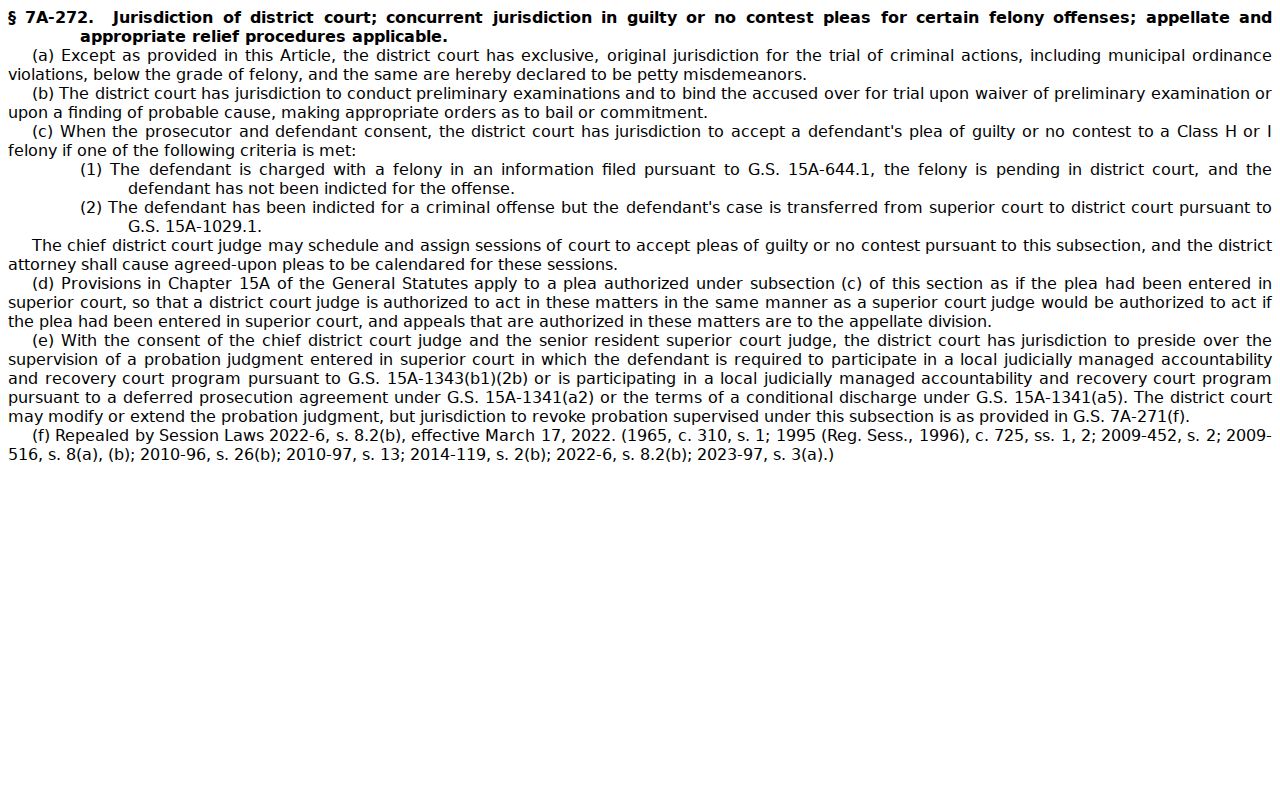
Read Moore County criminal docket results from the court assignment in the record itself. Do not infer it from where an incident happened or which agency issued a citation.
Criminal Dockets: What They Show
Portal labels the chronological docket for Moore County criminal cases the Register of Actions or Case Summary. Its header can show case and assignment information, party information, and status context. Case Events give the dated history. Dispositions state the system's recorded result, while Hearings holds the setting information in that module. Financial Information appears only when data exists. Public documents may appear after upload. But public visibility does not mean every document in a file is online.
| Case number | The Enterprise Justice identifier, such as format-only 26CR000001-620, ties the file to Moore County and case type. |
|---|---|
| Assignment information | Shows the trial-level placement. Confirm this before treating the case as a felony or a lower-level criminal matter. |
| Case Events | Chronological procedural entries, including docketable warrant or order-for-arrest events when public. |
| Hearings | Settings displayed for the case; use Search Hearings for the current location and time. |
| Status and disposition | Portal labels such as Active, Pending, Closed, Appealed, or a disposed form. Read later entries too. |
A disposition label is a system description. It does not replace the text of a court order. For an official copy, the right route is a clerk-certified document.
Moore County Criminal Docket Events
A Moore County criminal Register of Actions records steps, not a narrative. An issued warrant or order for arrest may be followed by several follow-on events. Those include return served, return unserved, reset-to-unserved, or recall. One event alone never states the current posture. Read the latest date first. Then review the status and hearing modules before assuming an earlier entry still controls.
- Case event
- A dated procedural action recorded in the Case Summary.
- Hearing
- A scheduled court proceeding. Current location and time are checked through Search Hearings.
- Continuance
- A postponement to a later date, usually reflected by newer docket or hearing information.
- Disposed–Trial by Judge
- A Portal status label indicating a case was decided by a judge rather than a jury or magistrate.
Note: Portal publishes no Moore-specific abbreviation key. Check unfamiliar shorthand against the full event description or with the clerk.
Moore County Criminal Docket Hearings
Portal keeps the chronological case history separate from the current-calendar search. Once the case is identified in SMART SEARCH, use Search Hearings to find a current setting. The tool accepts a case number, party name, business name, attorney name, bar number, judicial officer, courtroom, or date range. Then compare that result with the case's Hearings module and latest Case Events.
An online date can be unclear. Work the local access chain when it is. Review the civil and criminal links on the Moore County administrative-schedules page. Call District Court at (910) 722-5012 or Superior Court coordination at (910) 722-5016 as appropriate. Ask the Clerk at (910) 722-5000 about a public terminal or case-file question. Treat an old setting as history, not as a current hearing.
Criminal Case Stages on the Docket
A Moore County criminal Register of Actions usually moves from filing or charge events to an arraignment or first appearance, pretrial settings, a plea or trial, disposition, and any sentencing or financial entries. Not every case follows each step the same way. Magistrates handle limited preliminary functions, warrants, bail, and some minor pleas. The central clerk record stays unified throughout.
Docket flow: Filing or charge › arraignment or first appearance › pretrial setting › plea or trial › disposition › sentencing or financial entry
Need a current Moore County criminal setting? Switch from the historical event list to Portal Search Hearings. That tool takes several search keys. You can use a case number. A party or business name works, and so does an attorney or bar number. A judicial officer, a courtroom, or a date range can serve as the key. Remember that a past event date on the docket is no substitute for the live calendar result.
Moore County Criminal Docket Courts
Criminal work in Moore County is split across three routes. Moore County District Court takes misdemeanors and infractions. Superior Court handles the felonies. Magistrates sit inside the District Court structure, and they handle warrants, bail, preliminary criminal work, and certain minor pleas. None of this lives in police, sheriff, city, or county-clerk databases. All three routes run through the county's unified Clerk of Superior Court docket system.
The courthouse and clerk share one address: 102 Monroe St., Carthage. District Court lists (910) 722-5012. Superior Court coordination is (910) 722-5016. Magistrates answer at (910) 722-5019. A District Court misdemeanor appeal can move up to Superior Court for trial de novo under G.S. 7A-271. Watch for it as later case activity on the docket, and keep in mind the appellate record stays separate.
The criminal appeal statute gives the official description of that District Court-to-Superior Court route.
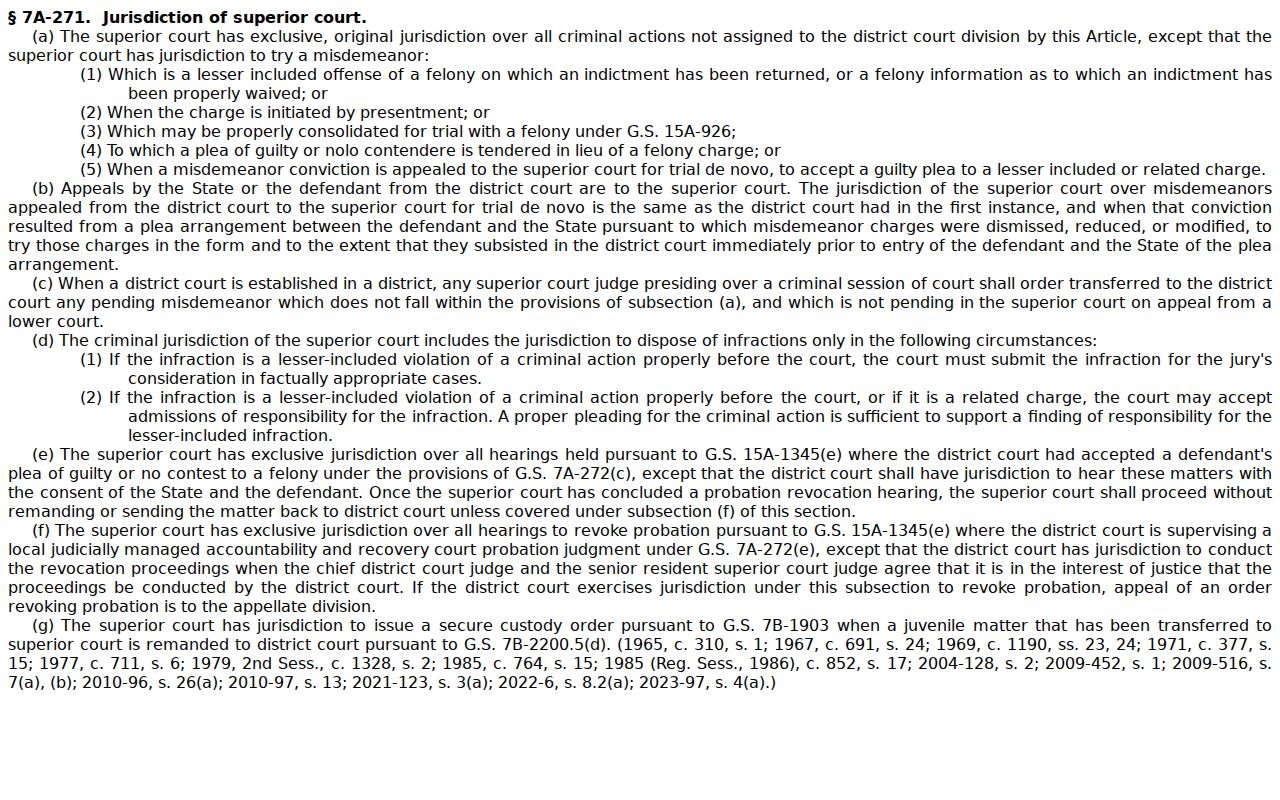
That split matters when you read a Moore County criminal docket result. Court assignment is one of the first things to check.
Moore County Criminal Docket Context
Handle Moore County criminal docket activity figures with care. The NCAOC FY 2023–24 Statistical Report counts 65 Class H/I felony guilty or no-contest pleas in Moore District Court. It counts 81 more in Moore Superior Court for FY 2024. Those are plea counts and nothing else. They say nothing about total filings. They do not cover all outcomes, pending volume, or how long any one case will run.
Numbers like these age quickly. Before relying on any current workload figure, the NCAOC criminal and infraction county activity reports are the proper official entry point for updated county reporting.
Reports add useful context on the court system. Still, confirm any current case date in the individual Moore County criminal docket itself.
Access Rules for Criminal Dockets
North Carolina opens clerk-maintained court records to public inspection for Moore County criminal dockets. That is the rule unless a law or court order says otherwise. Portal may display public, nonconfidential case information, docket entries, and uploaded documents. When a record is public but missing online, the courthouse terminal still works. So does the public paper file. Portal masks part of a public date of birth. It also does not expose Social Security number validation.
Sealed or confidential material never appears to ordinary Portal users. Juvenile records, unreturned criminal warrants, and some protective-order information carry special limits. A search error can cause a missing web result. So can a processing delay, historic paper material, or an unexpected category. The Moore Clerk will explain the access procedure. The clerk cannot disclose anything protected by law or order.
Key rules:
G.S. 7A-109 requires clerks to keep records, files, dockets, and indexes, generally open for public inspection during regular office hours.
G.S. 132-6 provides for reasonable inspection and copies of public records on payment of lawful fees.
G.S. 7B-3000 keeps juvenile records from public inspection except as the statute or a court order permits.
Moore County Criminal Docket History
Moore County joined eCourts Enterprise Justice on October 14, 2024. Portal now includes converted legacy cases from ACIS, VCAP, OCAP, CCIS, and PayNCTicket. Conversion does not guarantee that every historical paper file left the clerk's shelves. For older research, treat a no-result screen with caution. It is not a complete historical answer.
One quirk: older Moore County event rows can show a 12:00 a.m. time. That happens when the system converted a legacy date that had no actual event time. Treat it as a migration convention. It is not proof that a hearing, filing, or order happened at midnight. File & Serve is separate too. It is an authenticated e-filing service, not the public criminal docket.
The North Carolina District Court overview covers the state trial division. It handles misdemeanor and infraction dockets.
A legacy timestamp explains a display quirk and nothing more. For the case history itself, the Register of Actions and the clerk-held file remain the sources.