
How the Moore County Court Calendar Works
More than one official layer feeds the Moore County court calendar. For a current Moore County hearing, search the statewide North Carolina eCourts Portal. The Register of Actions, sometimes called a Case Summary, records the events behind a setting. Moore County also posts civil and criminal material through its local administrative schedules. Superior Court sessions set the frame for when the court sits. A session is not a promise. It does not mean your case will be heard that day.
Division matters here. Moore County Superior Court handles felonies and larger civil cases. Moore County District Court takes misdemeanors, infractions, family matters, and lower-value civil actions. A Moore County setting can sit in either division. The Clerk of Superior Court holds the local record either way. Check the assignment in the case file itself. Do not rely on the town name. The town named on a citation or filing is not a reliable guide.
Note: A listed Superior Court term is only a session schedule. Confirm the hearing in current case and hearing records.
Moore County Court Schedule Hearings
For a Moore County court date, Portal's Search Hearings tool is the live Moore County schedule channel. It searches by case number, party or business name, attorney name or bar number, judicial officer, and courtroom. Once a result appears, compare its time and location against the Hearings module in the related Register of Actions. Do that comparison. Chronological case events can preserve an older setting. A later hearing may already be active.
The official Portal training materials describe public search access. Search Hearings gives you current time and location. It will not say whether an appearance is virtual or in person. Ask the court or counsel about attendance. Treat the search result as a starting point. It is not a complete appearance notice.
Note: Begin with the most recent future hearing result. Then confirm any attendance detail Portal does not display.
Moore County Court Date Lookups
Match each channel to the job it does. Portal finds an active hearing by identifying information. Moore County schedule pages supply civil and criminal session context. When an online result is incomplete, a paper file is involved, or a setting needs direct confirmation, the Clerk, a Moore County court office, or the courthouse terminal is the fallback. A notice in a case file can help identify the matter. It should not override a later court update.
- Open Portal and use Smart Search with a party name or Enterprise Justice case number to locate the Moore County case.
- Select Search Hearings and use the case number, party, attorney, judicial officer, or courtroom to look for the current date and time.
- Open the Register of Actions and compare the current hearing with the Case Events and Hearings information.
- Check the Moore County administrative schedules for local civil or criminal calendar material and the current Superior Court terms.
- If the date is absent, close, or inconsistent, call the Clerk at (910) 722-5000, Superior Court coordination at (910) 722-5016, or District Court at (910) 722-5012; the courthouse public terminal is an in-person route.
These routes do different work. Portal is statewide and focused on current hearings. The courthouse terminal can supplement a web result and lead to a public paper file. A court office can answer the procedural question a displayed date cannot, especially when a cancellation or an appearance detail is at issue.
Moore County Court Schedule Links
The Moore County administrative schedules page is the local entry point. It collects civil and criminal calendar links. It complements Search Hearings rather than replacing it. A schedule shows the work of a court session. Portal then searches an individual file and its current hearing. Read the two together when a case is set during an announced calendar period.
The Judicial Branch's local rules and forms page collects Moore County materials for Superior and District Court practice. It helps with the civil calendar-request process. It does not let a public reader place another person's case on a calendar.
The official local schedules source lays out the schedule route Moore County actually uses.
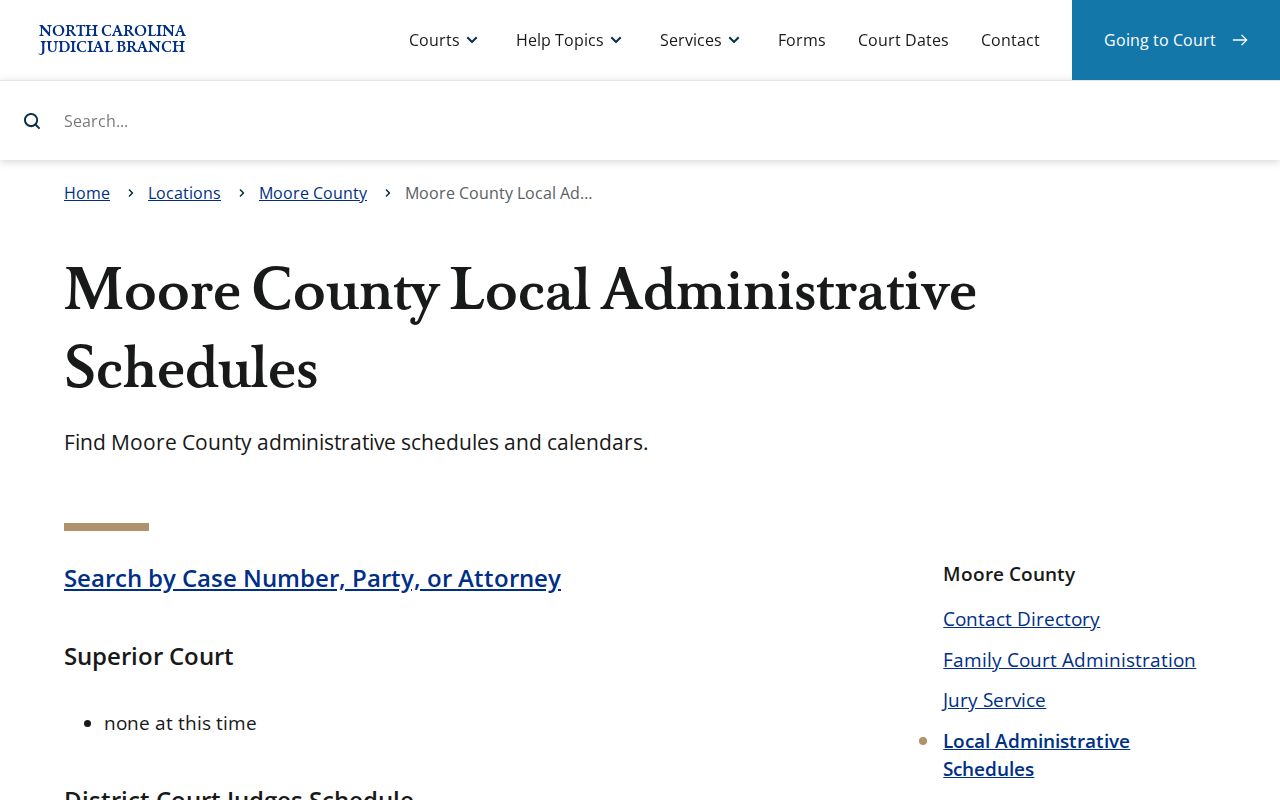
Local schedule links give session context, and you should always check that against the individual Moore County hearing result.
Court Settings: What Each Field Means
A court setting is a scheduled court event, nothing more. It is not a ruling. Read the date, time, courtroom, judicial officer, and setting type as one picture. A hearing can address a motion. An arraignment is a criminal charge and plea stage. A pretrial is preparation before trial. A jury or non-jury trial names the kind of trial setting. Give the current hearing record more weight than an older Case Event sitting in the file history.
| Date | The calendar date returned for the current hearing or shown in an entered case event. |
|---|---|
| Time | The scheduled time shown by Search Hearings; it is not necessarily a prediction of how long the matter will take. |
| Courtroom | The courtroom field, when displayed, helps distinguish simultaneous Moore County settings. |
| Judicial Officer | The judge or judicial officer search field can narrow a hearing search, but the current result controls. |
| Setting Type | A label such as motion hearing, arraignment, pretrial, jury trial, non-jury trial, or first appearance identifies the scheduled purpose. |
Portal may omit a Hearing or Financial Information module when no data exists. A missing module alone does not prove the underlying file is missing.
Moore County Court Schedule Fields
Search Hearings leans on identifiers that connect a calendar result to an actual court file. The case number is usually the fastest path. Party and business names work well when that number is unknown. Fields for attorney, bar number, judicial officer, and courtroom can tighten an active calendar search. One search criterion is the minimum the tool accepts. Before treating any court date as belonging to a specific Moore County matter, do one more step. Match the result to the case number first.
- Hearing
- A scheduled court proceeding that may appear in Search Hearings and in a case's hearing module.
- Setting
- The scheduled date and time for a court event; compare it with the current schedule and case history.
- Continuance
- A court-ordered postponement of a scheduled matter to a later date.
- Case Event
- A dated procedural entry in the Register of Actions, which can preserve prior settings and later updates.
Note: Search Hearings shows a current setting but does not flag virtual appearances. Get any remote-access instructions straight from the court.
When a Court Date Moves
Schedule labels mean less than people assume. A continuance postpones a matter. A reset marks a setting that moved. A cancellation may pull a matter off one calendar. None of these means dismissal. To see where a Moore County case actually stands, read the dated event history in the Register of Actions, then check Search Hearings and the local calendar for the newest active setting. Because the Portal guide lists docketable events in order, an older date can stay visible even after a hearing moves. For civil Superior Court matters, the calendar request form shows why a requested date is never automatic. A motion has to be filed before it can be calendared. The request itself asks for estimated hearing time and certifications about consultation and agreement. A requested session and a confirmed individual hearing serve different purposes.
Moore County Court Schedule Terms
The 2026 Moore County Superior Court terms name when Superior Court sessions occur. That context helps when a matter is expected in a Superior Court session. But terms are not an individual case calendar. They cannot confirm a courtroom, a time, or whether a setting was continued. Search Hearings and the Moore County Register of Actions carry those case-specific details.
Think of a term as a broad window for a court session. A setting is the event tied to one case. When they seem to clash, ask the Superior Court coordinator or the Clerk. They can say which current court record governs. That beats an assumption. A case will not always be heard on the first day of a listed term. The published term schedule is a planning source. A case-specific hearing search confirms the real court date.
Missed Settings and What Comes Next
Act quickly after a missed Moore County setting. Start with Portal Search Hearings and the Register of Actions, then contact the Clerk or the right court office for the local procedure. A judge can sometimes strike a failure to appear and set a new date, but that outcome is never guaranteed. In civil and criminal matters alike, the court decides whether a continuance or rescheduling happens at all.
Missed a Setting? A traffic case may be marked called and failed, and an unresolved matter can lead to a Failure to Appear after the statutory period, possible fees, DMV notice, or an arrest order or bond consequence depending on the case.
Contact the Clerk promptly and follow the court's current instructions rather than waiting for an old calendar date to change itself.
Consult a licensed attorney about a missed Moore County court setting when legal advice is needed.
Moore County Court Schedule Requests
Need a trial or motion set in Moore County civil court? The Civil Superior Court Calendar Request is the local form for that. It asks for the parties, the file number, the session beginning, and the motion type. You also mark jury or non-jury. Give the date the motion was filed, and note an approximate hearing time. You certify that you consulted the other parties. The original goes to the Moore Clerk. A copy goes to the Judicial Assistant through the stated channels.
One warning from the form itself matters. A motion will not be calendared until it is filed. So this is a tool for a party or attorney with a live case. It is not a way for the public to book a hearing. If you just want the date on an existing case, try Portal, the posted calendar links, or the court's confirmation channels instead.
For a look at the identifiers and certifications Moore County civil settings require, the official calendar-request form shows them in full. Use it before you file.
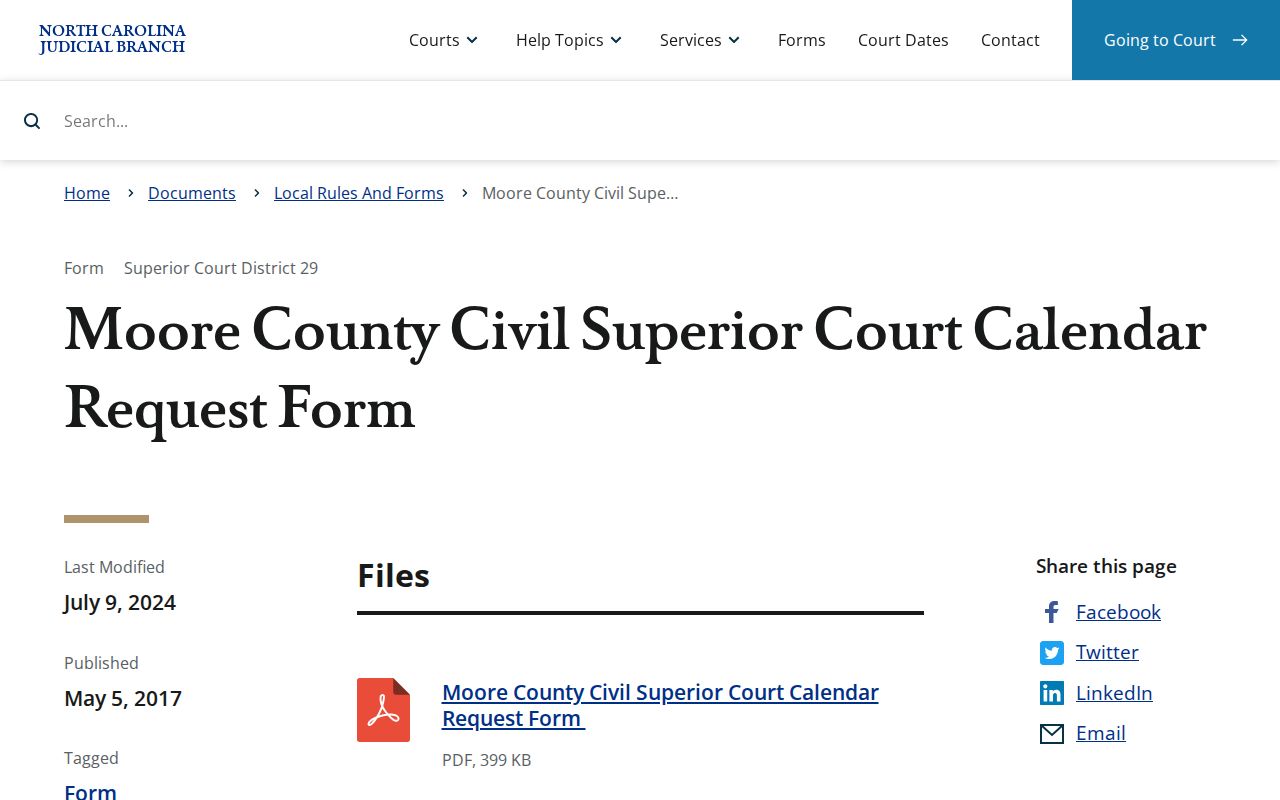
Those form fields show why a requested session differs from an already confirmed court date.
Moore County Court Schedule Event History
Reading Case Events in order is how a continuance makes sense. Find the case first. Then pick out the older hearing entry. Grab the continuance or reset event if one appears, and the newest future result in Search Hearings. This sequence prevents a classic error with Moore County court records: treating a past scheduled date as live simply because it still sits in the Register of Actions. Portal's public Case Summary can hold case information, party information, assignment details, case events, hearings, dispositions, financial information when applicable, and public documents. Current hearing information sits in its own layer within that record. When the web record runs thin, Moore County's courthouse self-service terminal and the Clerk's paper-file route still carry public material. The official local-rules source documents the forms that work alongside the Moore County schedule process.
Local rules and forms add procedural context, while the current court hearing record controls the operative setting.