
Moore County Court Record Requests
A request for a Moore County case file starts at the Clerk of Superior Court. Portal shows the public Register of Actions and any public documents filed there. For the courthouse terminal, paper files, plain copies, or certifications, the clerk's office is the stop. Call (910) 722-5000. Staff can sort out the right route for a historical file, a document copy, certification, or a restricted-access question.
One office covers it all. The Clerk keeps the county case file. That file covers Moore County Superior Court, District Court, magistrate, criminal, civil, traffic, special proceeding, and estate records.
- Use Portal or the courthouse terminal to locate the case number and identify the exact record needed.
- Choose the access route: public online viewing, a public terminal or paper-file visit, or a request to the Moore County Clerk for a plain, certified, or exemplified copy.
- Give the clerk the case number, parties, and the document name or record type, then ask for a cost estimate before a larger request.
- For an in-person request, use the Clerk's public office at the courthouse. For mail or another remote case-copy process, confirm the current clerk instructions first because no official general document-copy order procedure was located.
- Use the NCAOC public-records form only for an existing Judicial Branch agency record that NCAOC holds, not to retrieve a Moore County case file.
Access works as a chain. It runs Portal, the Moore County clerk counter, the self-service terminal, phone contact, and a remote-copy route the clerk confirms. The statewide system helps you find the file. It does not make the state agency the custodian of a local court document. Note: Confirm the Clerk's current remote-copy instructions before mailing any request. Moore County posts no general case-copy mail procedure.
Moore County Court Records at the Clerk
The Moore County Clerk of Superior Court keeps the county's court files. The courthouse sits at 102 Monroe St., Carthage, NC 28327. Mail goes to PO Box 936, Carthage, NC 28327. Public hours are 8 a.m. to 5 p.m. on weekdays. The main number is (910) 722-5000. That listing comes from the official Judicial Branch directory. This is the office for inspecting a public paper file, using the self-service terminal, ordering copies, or getting a clerk-certified document.
Portal's public view helps, but it is not a promise that everything filed is online. Older documents, missing images, and non-electronic records may need the terminal or the paper file. The Moore County clerk can certify case-file documents. NCAOC cannot.
Moore County Clerk of Superior Court
102 Monroe St.
Carthage, NC 28327
(910) 722-5000
Note: Parking at the courthouse is limited, so check the official courthouse information and current closure notices before you travel.
Kinds of Court Records
"Court record" covers several things. The Register of Actions is the index and the chronological timeline of the case. Filed documents are the pleadings, notices, orders, and judgments sitting behind selected docket events. A certified copy is a copy the clerk authenticates as official. Know which one you need before you call. Viewing on Portal, a plain copy, and certification are separate services with separate fees.
- Register of Actions or Case Summary, showing case information, parties, assignments, events, hearings, status, and dispositions when available.
- Public filed documents, including available pleadings, notices, orders, and judgments uploaded to Portal.
- Criminal, traffic, civil, family, special proceeding, estate, and small-claims case files held through the unified clerk system.
- Plain copies, certified copies, and exemplifications of a clerk-held record when the law permits access.
- Transcript or hearing-recording material, which follows a court reporter, transcriptionist, or clerk-recording route rather than an ordinary document-copy request.
The case type decides the court division and can affect public access. It does not create a new clerk. Across all trial-court categories, the Moore County Clerk remains the local case-file custodian.
Moore County Court Record Form Limits
The Judicial Branch public-records request form serves one narrow purpose. It reaches existing records kept by the Administrative Office of the Courts. You supply your contact details and describe the record you want. That is all it does. It cannot make NCAOC pull a Moore County case file or build a new compilation for you. The form's own notice points people toward the clerk in the county where the case was filed. Moore County court documents and case information go through the Moore Clerk.
This split in duties saves people time. NCAOC policy makes inspection of its agency records free. It normally lists public-record copies at $0.25 a page. That figure governs agency records only. It does not set what the Moore Clerk charges to copy a case file. For a Moore County judgment, order, docket record, or certified case document, one office is the right contact. The Moore Clerk handles those requests. The official public-records form spells out the state-agency request route, which is separate from any request filed with Moore County court staff.
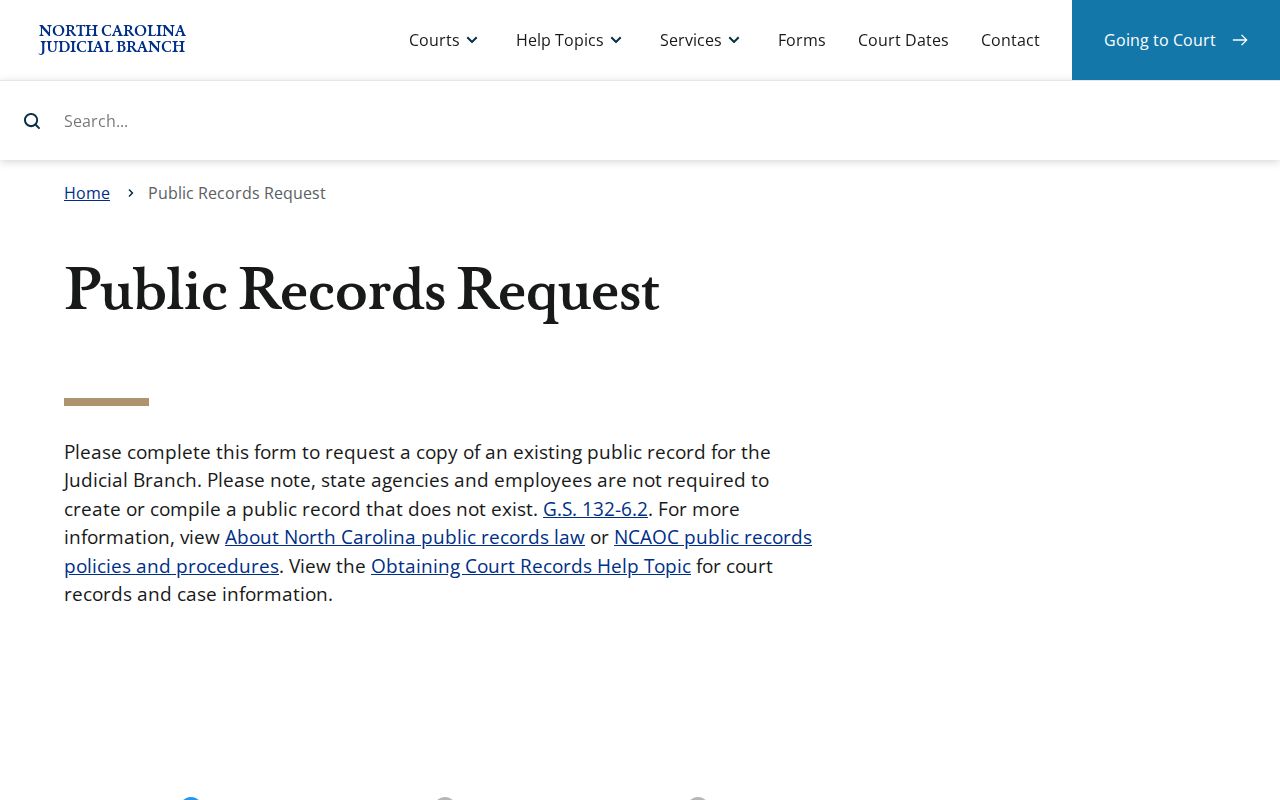
Filling out the agency form does not move a Moore County case file from the clerk to NCAOC. Custody stays where it was. Note: Use the form only for existing NCAOC records, not for a case document held in the Moore Clerk's file.
Moore County Court Records Terminal
North Carolina court guidance puts a public self-service terminal in a clerk of court's office in every county. The Moore County Clerk has one. The terminal offers in-person access to public criminal, civil, special proceeding, and estate information. Criminal searches run by defendant name, case number, or victim or witness name. The kiosk guidance lists Portal, Guide & File, File & Serve, printing, and scanning among its functions. The terminal shines when a public case result is hard to see online or a historical paper file needs checking. It cannot override a seal, a confidentiality rule, or a court order.
Bring the case number if you can. Ask the clerk about material Portal does not show. The official court-records guidance describes the clerk-office terminal and county case-file routes.
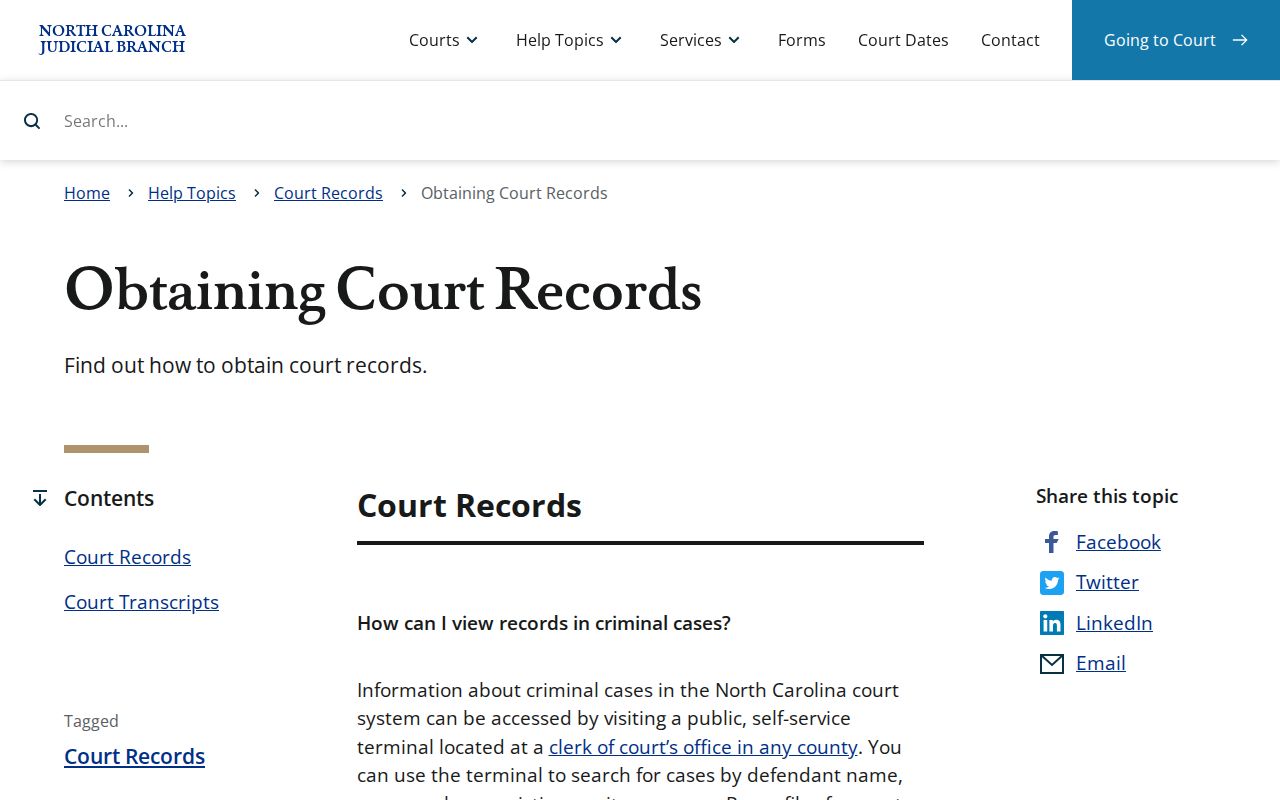
The courthouse terminal supplements Portal and connects a Moore County court-record search to the clerk-held file.
Court Records: What They Contain
Open a Moore County Portal result and you may get a full Register of Actions. It can hold case information, party details, assignment information, case events, hearings, dispositions, financial information when applicable, and public documents. The case number holds it all together. In Enterprise Justice, that number pairs a two-digit year with case-type letters, a six-digit sequence, and a three-digit county identifier. Moore County's identifier is 620. So a format-only example looks like 26CR000001-620.
| Case Number | The court identifier; use it to locate the Register of Actions and request the right clerk-held file. |
|---|---|
| Case Information and Parties | Shows basic case details, the parties, and their roles when public. |
| Case Events | The chronological docketable event history behind the case record. |
| Hearings and Dispositions | Shows scheduled proceeding information and case outcome or status information when available. |
| Documents | Public, nonconfidential, nonsealed documents may be viewable one at a time after upload; the clerk file can contain material not available online. |
A document displayed on a screen is not the same as an authenticated record. When you need official certification, ask the clerk for a certified copy.
Moore County Court Records and Transcripts
Transcripts work differently from ordinary clerk copies. Per the Judicial Branch, an official court reporter makes a verbatim record of a proceeding, while a transcriptionist can turn an audio recording into a written one. To order a transcript, reach the court reporter who attended the proceeding. An appropriate transcriptionist also works. Rates are set independently.
Recordings are a separate path. If a clerk or digital technician recorded a nonconfidential hearing, request a copy of that recording through the county clerk on AOC-G-114, paying actual CD cost if available. Criminal District Court proceedings generally are not recorded, subject to stated exceptions. And a District Court criminal appeal proceeds as a new Superior Court trial, so a transcript is generally not needed on that route.
Note: Before ordering anything, ask whether the material you need is a case document, an official transcript, or a recording. Each one runs through a different office and process.
Copy Fees and Certification
G.S. 7A-308 sets the clerk fee schedule that matters most for Moore County case-file copies. The first page of each copied document carries one charge. Each added page or fraction costs less. The statute also sets fees for a certificate under seal, exemplification, and a single-county certified criminal-record search. Before a large request, ask the Moore County Clerk for an estimate. Turnaround times and any mailing charge can vary.
| Moore Clerk record item | Statutory fee or rule |
|---|---|
| First page of each copied document | $2.00 under G.S. 7A-308(a)(12). |
| Each additional page or fraction | $0.25 under G.S. 7A-308(a)(12). |
| Certificate under seal | $3.00 under G.S. 7A-308(a)(9). |
| Exemplification of record | $10.00 under G.S. 7A-308(a)(10). |
| Single-county certified criminal-record search | $25.00 under G.S. 7A-308(a)(17); it is not statewide. |
The $0.25-page figure in NCAOC policy applies to that agency's own public records in the normal course. It does not replace the clerk's statutory schedule for case documents.
Moore County Court Record Fee Details
Plain copy, certification, and exemplification are not interchangeable. A plain copy just reproduces the document. A certificate under seal is a clerk certification. An exemplification is a higher-authentication form of court record. Viewing a file on the Portal replaces neither Moore County clerk service, so name the exact document and the authentication level you need before the clerk prepares it.
North Carolina's public-records law permits inspection of public records and copies on payment of lawful fees. For uncertified copies, G.S. 132-6.2 generally limits an agency to actual cost, while statutes control certification charges and exceptional work may support a permitted service charge. No docket-sheet-specific fee, general case-copy mail fee, or assured turnaround appears in the statutes, so the right move is to ask the clerk directly.
The clerk inspection statute lays out the clerk's recordkeeping and public-inspection duties alongside the fee schedule.
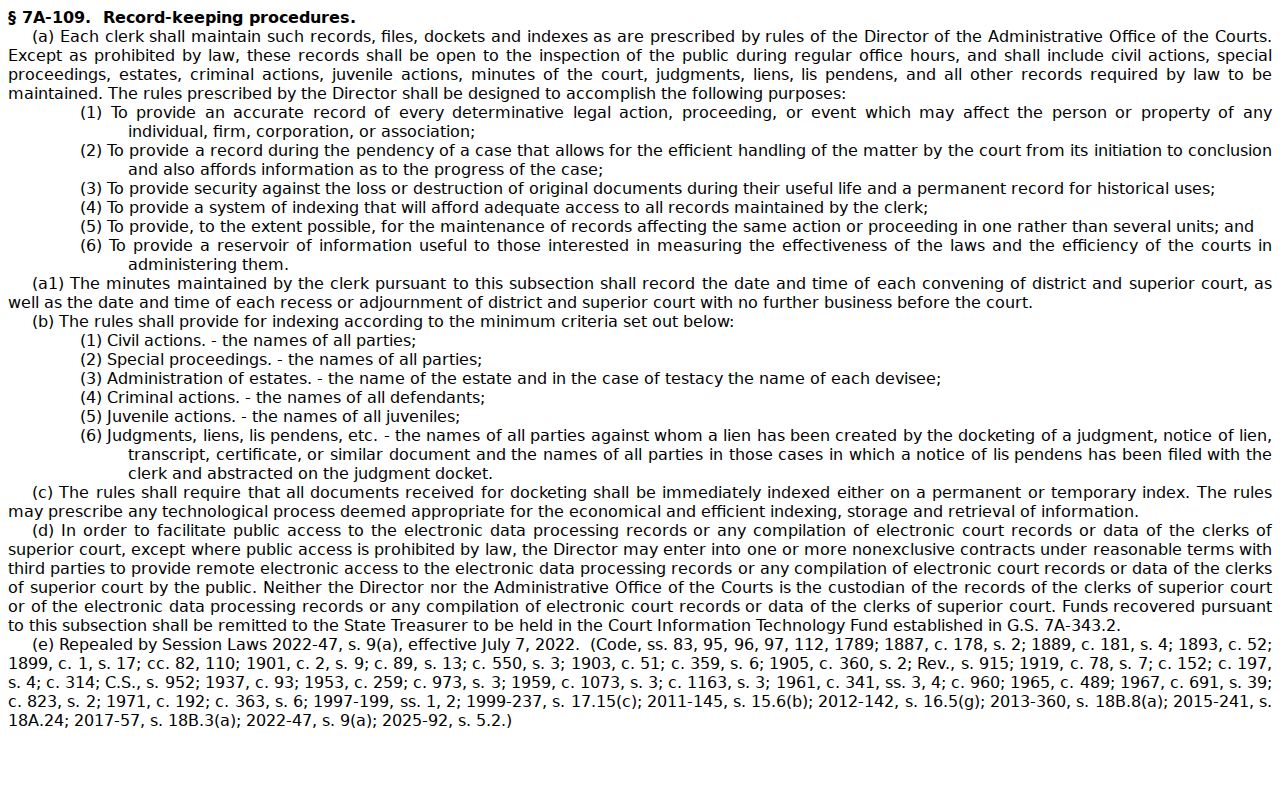
Treat the statutory schedule as a starting point. Confirm the real cost of your Moore County request with the clerk.
Note: The statutory items set no guaranteed turnaround, mailing charge, or separate docket-sheet fee for a Moore County request.
Moore County Court Record Certification
Need a Moore County certified judgment, order, or other court document? First find the case number and the exact document. Use Portal or the clerk terminal. Then tell the Moore Clerk that you need certification or exemplification. Request a cost estimate. Follow the clerk's current delivery instructions. The clerk in the county where the case was filed is the official certifying custodian. That office holds the case file.
Portal documents help you identify the material, but their availability guarantees neither certification nor completeness. A large Portal document may return error ER141011. It is too large to open. Official guidance says the Clerk of Court may need to reprocess or split that document. Contact the clerk rather than assuming the item is unavailable or asking NCAOC for it.
The NCAOC public-records policies separate agency records from clerk-held court documents. They confirm that NCAOC cannot certify case-file records.
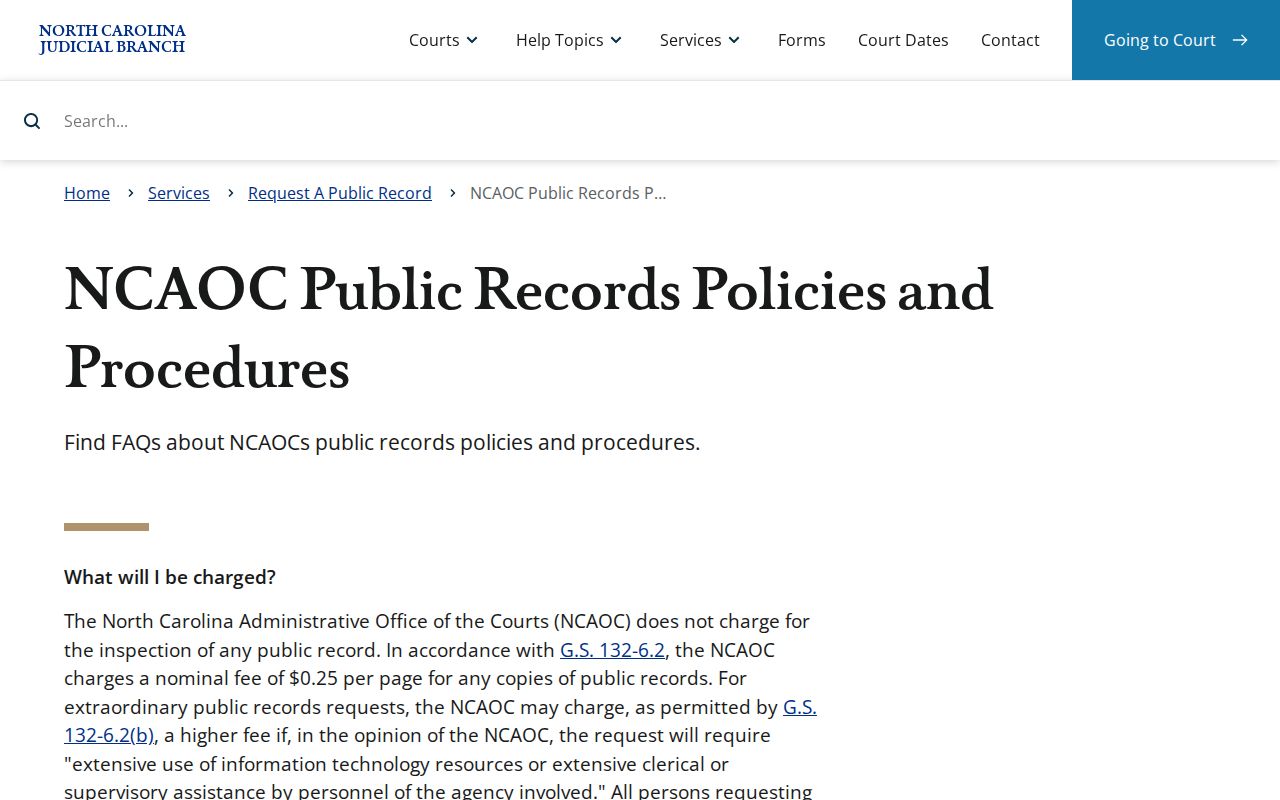
State agency policy points to one conclusion: a Moore County certified court record has to come from the county clerk.
Access Rules for Court Records
Public access in Moore County starts with a presumption, not an unlimited right to every file detail. G.S. 7A-109 requires clerks to keep court records, files, dockets, and indexes and, unless disclosure is prohibited, to open them for public inspection during regular office hours. G.S. 132-6 requires public-record custodians to permit reasonable inspection and furnish copies promptly on payment of lawful fees. Portal viewing can serve as an online access channel. It covers material the public is allowed to see.
Key rules:
G.S. 7A-109 requires clerk recordkeeping and public inspection unless law prohibits disclosure.
G.S. 132-6 protects reasonable inspection and copying of public records on payment of lawful fees.
G.S. 132-6.2 addresses actual-cost limits for uncertified copies and permitted charges for extraordinary work.
G.S. 7B-3000 restricts public inspection of juvenile records except as statute or court order permits.
Anyone seeking a public record can inspect or request it through the correct custodian. That right does not open a confidential item, and it never substitutes for a clerk certification.
Moore County Court Records Online Limits
Public by law does not always mean visible online. The Moore County Portal excludes sealed cases, confidential data, and restricted documents from ordinary public access. It also masks the month and day of a recorded date of birth. It does not permit SSN validation. Official FAQ materials name juvenile records, unreturned warrants, and protective-order material as categories with restrictions or elevated-access rules.
Domestic-violence and protective-order records carry special web-indexing limits. A file can be open to the public at the clerk under applicable law. Its public web display can still stay restricted. So an absent online result has several possible causes. It may reflect a name or case-number issue, a restriction, an unprocessed document, or a historic paper file. Then ask the Moore Clerk about the lawful access procedure.
The Judicial Branch public-records law explanation lays out the rules for inspection, redaction, and copying.
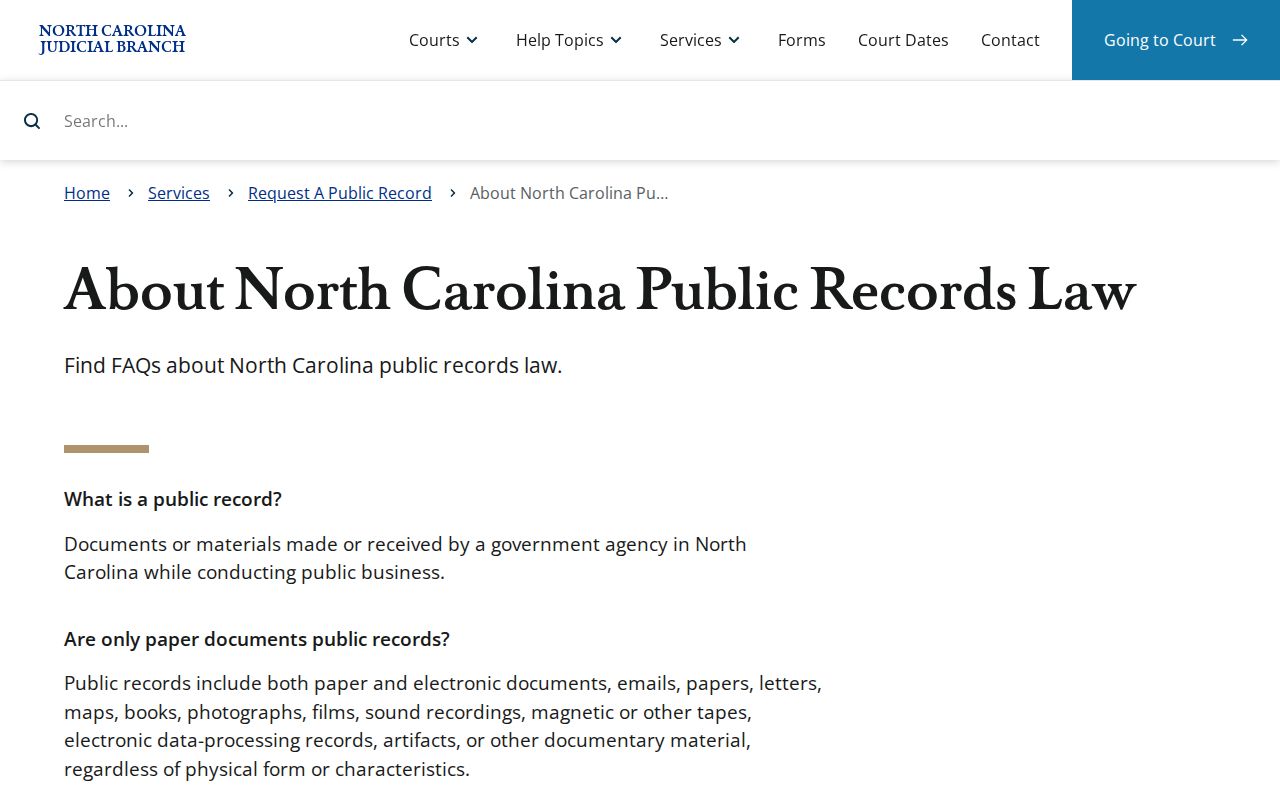
Redaction and confidentiality can narrow an online image. Neither one removes the clerk's role as the source for lawful access questions.
Note: The Clerk can explain access procedure, but may not disclose a record that a statute or court order protects.
Moore County Court Records History
Older records deserve an extra inquiry. Moore County history states that the brick courthouse built in 1840 burned in 1889. The fire took county records with it. Tax books and superintendent material were lost. None of that proves every court docket or court file burned too. The current historic courthouse, started in 1922 and dedicated in 1923, stands on that history. An online no-result is therefore not a conclusion about a nineteenth- or early-twentieth-century Moore County court record.
Moore County entered eCourts Enterprise Justice on October 14, 2024. Portal holds converted legacy information. Yet the official FAQ says historical paper files may still exist with the clerk. When you ask about older material, give the clerk the case year and party names. Include any known case details. That helps direct an archive or paper-file request. It does not assume a complete digital run.
The Judicial Branch request information explains the agency request route and directs local case-file requests to the county clerk.
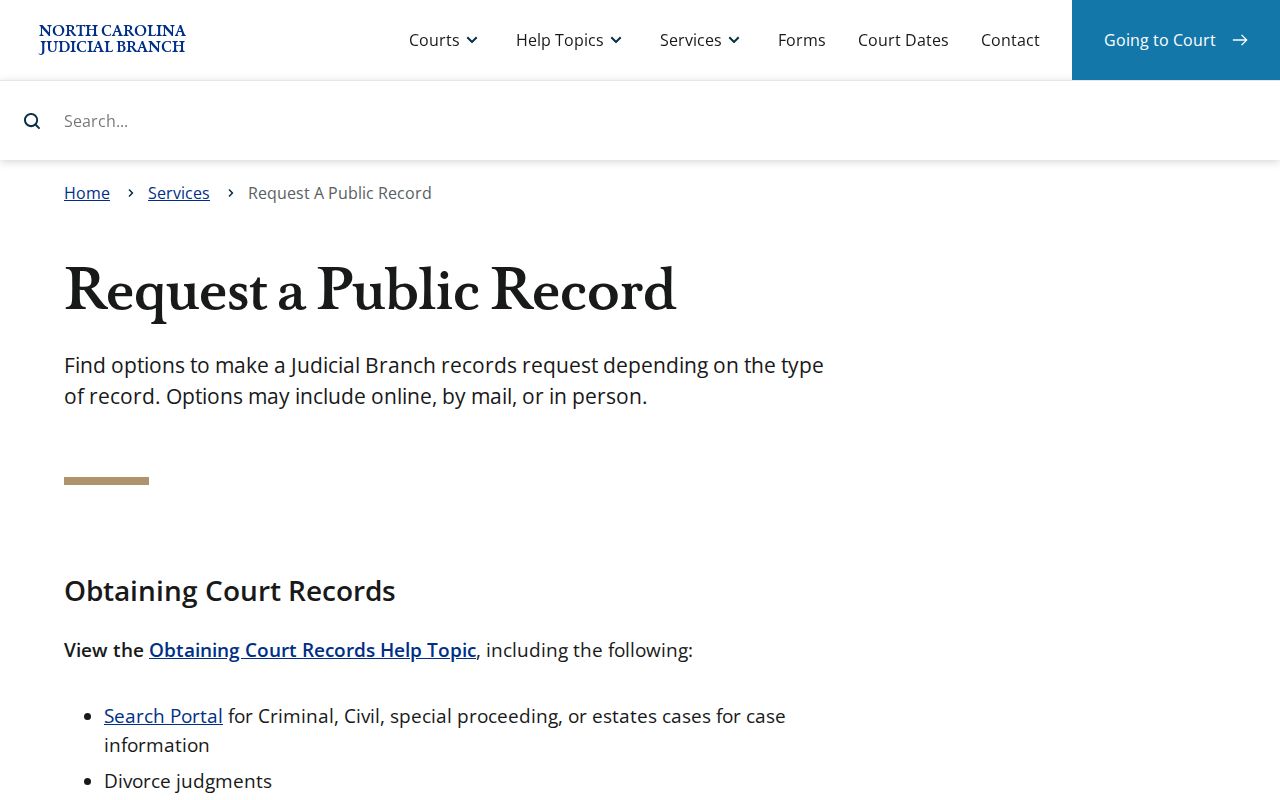
For an old Moore County court file, ask the clerk directly. The historical paper-file route usually tells you more than an online result alone.